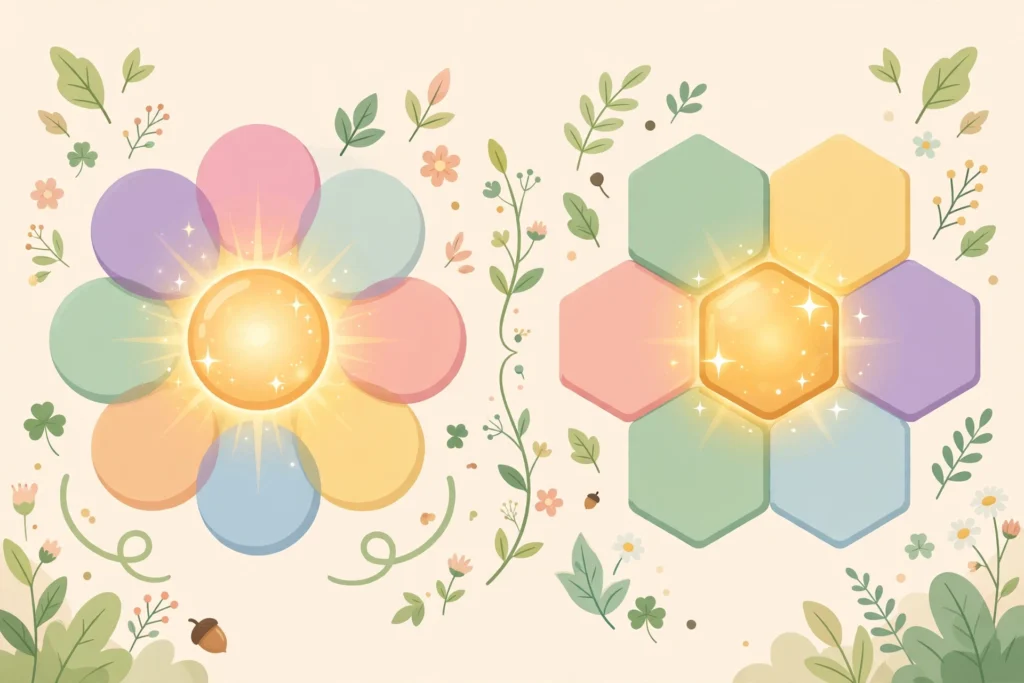
Quick answer: Blossom and Spelling Bee look like twins at first glance. Both hand you seven letters, one required center letter, and a daily puzzle. The split is in the goal. Blossom asks you to pick just twelve words and score them well, with a rotating bonus letter that can double a word. Spelling Bee style play asks you to find as many accepted words as you can and climb score ranks. Same letters, very different decisions.
People often land on one of these games after playing the other, and the first surprise is how familiar everything feels. Seven letters arranged around a center. Words of four letters or more. A pangram waiting somewhere in the mix. Then the second surprise arrives: the habits that won yesterday’s puzzle quietly work against you today. This guide walks through what the two formats share, where they part ways, and how to adjust your play when you switch between them.
What the two games share
The bones are nearly identical. Each puzzle shows seven letters with one sitting in the middle, and that center letter has to appear in every word you submit. Words need at least four letters. You can reuse letters as often as you like, so a single promising petal can show up in word after word. Proper names, hyphenated forms, and most obscure slang sit outside the accepted list in both games.
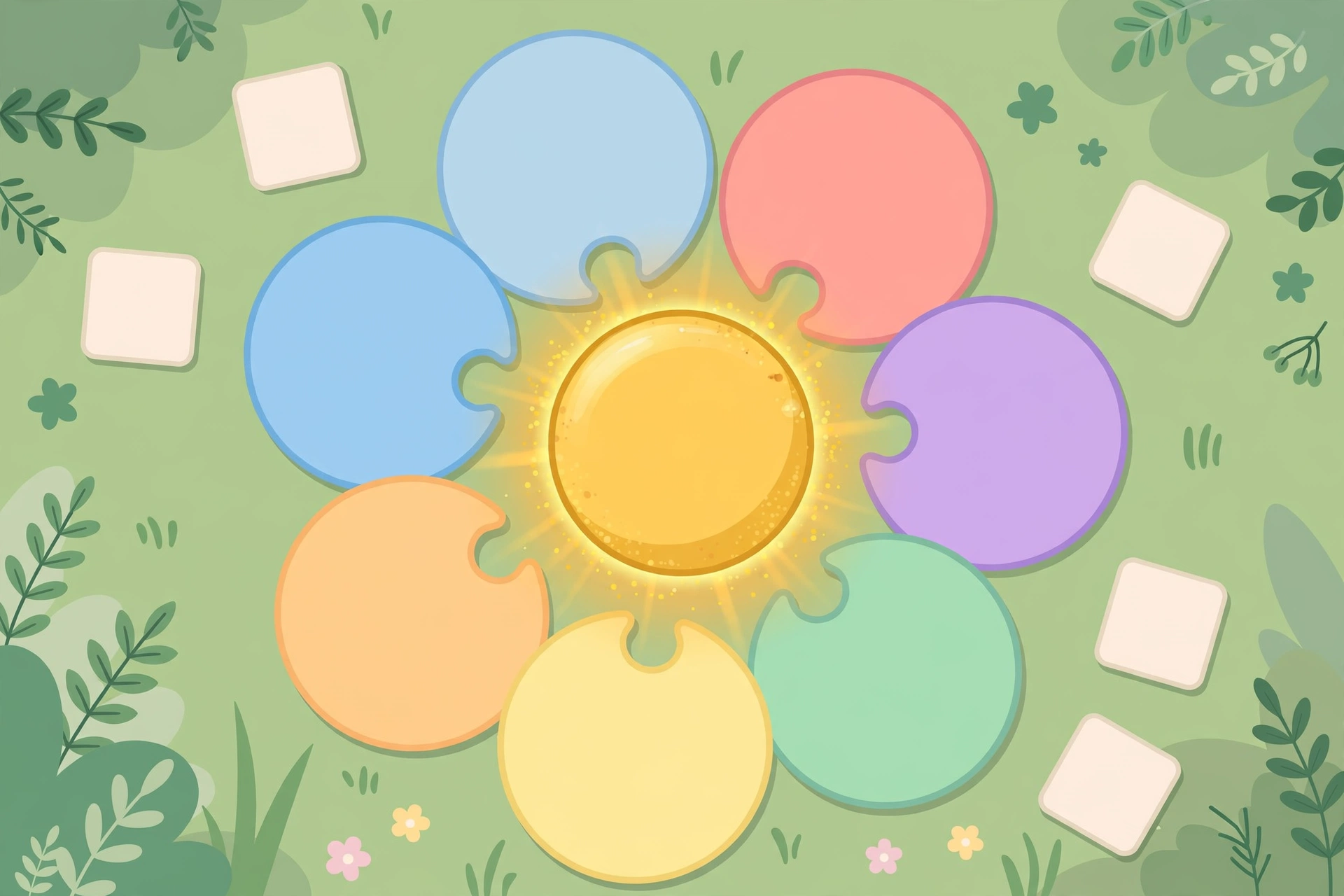
Both games also feature a pangram, a word that uses all seven letters at least once. Finding it feels like cracking the puzzle open, and both games reward you for it. Word-building instincts transfer cleanly between the two: hunting for common endings like -ing, -ed, and -tion, testing prefixes, and shuffling the letters when your brain gets stuck on one pattern. If you are decent at one game, you already own most of the raw skill for the other.
The objective is where they split
Here is the real difference. In Blossom, your list stops at twelve words. That is it. Every slot is precious, so each submission is a small wager. Do you spend a slot on the safe six-letter word you see right now, or hold out for something longer that the bonus letter will reward? A short word that feels harmless in another game can quietly cost you points here, because it took a seat a stronger word needed.
Spelling Bee style play flips that pressure. There is no slot limit. The accepted list for a single puzzle can run past a hundred words, and your job is to find as many of them as you can. Points move you through ranks, from beginner levels up through Genius and, for the truly stubborn, Queen Bee, where every accepted word has been found. Submitting a short word costs nothing but a second of your time. Discovery is the whole game.
Scoring works differently too
Blossom scoring rewards choosing well. In the practice version on this site, a four-letter word earns one base point, and words of five letters or more earn one point per letter. One outer letter carries a bonus each turn, and if your word contains that letter, the word’s value doubles. A seven-letter bonus word jumps from seven points to fourteen. A pangram adds seven more points on top. You can read the full breakdown in our guide to blossom game scoring, including worked examples.

Spelling Bee scoring is plainer. Four-letter words earn one point, longer words earn a point per letter, and a pangram adds a flat seven-point bonus. There is no rotating bonus letter and no doubling. Your total is mostly a measure of how much of the hidden list you uncovered. That makes the two scores impossible to compare across games. A Blossom score reflects twelve careful picks. A Spelling Bee score reflects endurance and vocabulary range.
Dictionaries: same letters, different answers
Play both games on the same day and you will eventually type a word one accepts and the other rejects. That is not a bug. Each publisher maintains its own word list, with its own calls on slang, variant spellings, and borderline terms. One list leans generous, the other leans strict, and neither one simply copies a desk dictionary.
What does that mean in practice? Stop treating a rejection as a spelling mistake. When a word bounces, run a quick check: did it include the center letter, was it long enough, did it use only the letters on the board? If it passes all three, the word probably just is not on that game’s list. Note it and move on. Players who keep a small list of repeat rejections learn each game’s taste within a couple of weeks. Our blossom game rules page lays out the checks in order, so you can diagnose a rejected word in seconds.
Time, rhythm, and how a session feels
A round of Blossom usually wraps up fast. Twelve decisions, some shuffling, a bit of second-guessing near the end, and you are done in five to ten minutes. It fits a coffee break. Spelling Bee can stretch. Many players keep it open all day, dipping in whenever a new word pops into their head on the bus or in the shower. Ranks give you natural stopping points, but the puzzle never really says “finished” until you hit Genius or give up for the day.
Neither rhythm is better. They just suit different moods. Blossom is a sprint with a strategy layer. Spelling Bee is a slow scavenger hunt. Plenty of daily players do both, one with breakfast and one spread across the day.
Which one should you play?
Pick Blossom if you like optimization. If the fun for you is squeezing maximum value out of limited choices, timing a long word to land on the right bonus letter, and beating yesterday’s total by three points, this is your game. Pick the Spelling Bee style if you like collecting. If you enjoy the slow drip of new discoveries, obscure words surfacing at odd moments, and the long climb through the ranks, you will feel at home.
Still torn? Play each for a week and watch which one you open first in the morning. That instinct tells you more than any comparison chart. You can also browse games like Blossom if you want a third style in the rotation, since many of them borrow pieces from both formats.
Skills that transfer between both games
The good news is that practice in one game feeds the other. Building words around a center letter, spotting suffixes, and recognizing pangram potential are shared muscles. Where players trip up is timing. In Spelling Bee, you submit the moment you spot a word. In Blossom, spotting is only step one. You park candidates, rank them, and submit in an order that respects the bonus letter and your twelve slots.
A simple habit bridges the gap: keep a scratch list. Jot down every candidate word you find, in either game. In Spelling Bee it prevents repeats. In Blossom it becomes your draft board, the pool you choose your twelve from. Two minutes of listing before your first submission will raise your Blossom score more than any single trick.
Frequently asked questions
Is Blossom harder than Spelling Bee?
They test different things. Spelling Bee is harder to fully complete because the accepted list is long and Queen Bee demands every word. Blossom is harder to optimize, since twelve slots punish careless picks. Most players find their first week of Blossom trickier, then the difficulty evens out.
Can a word be a pangram in one game and rejected in the other?
Yes. Pangram status depends on the letters, but acceptance depends on each game’s own word list. A word that uses all seven letters can still be missing from one publisher’s list, so it scores as a pangram in one game and gets rejected in the other.
Why does Blossom limit you to twelve words?
The limit is the strategy. With unlimited submissions, the best play is to enter everything you can think of. With twelve slots, you have to judge word quality, watch the bonus letter, and decide when a candidate is good enough. The cap turns a word hunt into a planning game.
Do both games change daily?
Yes, both formats run on a daily puzzle with a fresh set of seven letters. There is one featured puzzle per day, which is why scores and pangrams from the same date are comparable between friends playing the same version.
Which game is better for building vocabulary?
Spelling Bee style play exposes you to more words, because you are chasing a long list and bumping into unfamiliar entries. Blossom teaches depth instead: letter patterns, flexible roots, and how words are built. For pure vocabulary growth, volume wins, so the edge goes to Spelling Bee.
Can I play both games on my phone?
Yes. Both work in a mobile browser with touch controls, and neither requires a download to try. A bigger screen helps when you are scanning for pangrams, but most daily players happily play on a phone.
Blossom vs spelling bee: one final check
Set side by side, blossom vs spelling bee is a contest of limits: blossom vs spelling bee players face the same seven letters and center rule, yet blossom vs spelling bee scoring rewards opposite instincts. Read blossom vs spelling bee rounds by mood: pick the twelve word sprint when you want a plan, and the long list when you want volume. Follow our blossom game strategy guide for the Blossom half, and settle any disputed word in a standard dictionary such as Merriam-Webster. Either way, a blossom vs spelling bee habit sharpens the same core skill, and blossom vs spelling bee practice transfers both ways.
Keep this blossom vs spelling bee comparison nearby for a week of mornings: whichever you open first, the other waits, and blossom vs spelling bee together make a complete daily workout, because blossom vs spelling bee cover speed and stamina in one pairing.